
Where Father Beirão planted the seed with his missionary soul, Blessed Maria Clara caused the shelter of hospitality to blossom. Two lives offered for a single purpose: to be the face and the hand of God’s mercy among humankind.
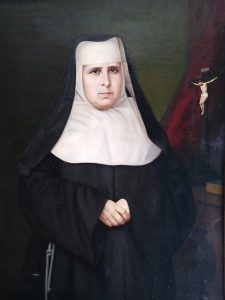
Blessed Maria Clara of the Child Jesus, born Libânia do Carmo Galvão Mexia de Moura Teles e Albuquerque, came into the world within a noble family on 15 June 1843, at Quinta do Bosque – Amadora. She was the daughter of Nuno Tomás de Mascarenhas Galvão Mexia de Moura Telles e Albuquerque and Maria da Purificação de Sá Carneiro Duarte Ferreira, who had her baptised on 2 September 1843 in the Church of Our Lady of Amparo, Benfica.
Her lineage promised the comfort of palaces, yet destiny reserved for her the crucible of trial. Left to herself in the early dawn of youth, Libânia always revealed a spirited nature and an unshakeable character, shaped not only by the complexities of childhood but by a succession of sufferings that accompanied her until the end of her days.
Even within the seclusion of the Royal Asylum of Ajuda and, later, amid the luxury of the Palace of the Marquises of Valada, Libânia felt that noble blood was not enough. Her heart longed for a greater nobility: that of service. The cry of the “have-nots” echoed more loudly than the courtly dances.
Driven by this inner force, she set aside silk to clothe herself in charity. In 1869, at the House of St Patrick, she embraced the ideal of St Francis, and Sister Maria Clara of the Child Jesus was born. Her novitiate in Calais, France, became the prelude to the foundation of her own Congregation in Portugal in 1871.
For 28 years, she was the face of mercy. Under the motto “Let us work with love and for love”, she founded more than 142 works. From hospitals to charitable kitchens, her embrace reached Angola, Goa, Guinea and Cape Verde. For Maria Clara, there was no “surplus humanity”: every poor person and every sick person was Christ Himself asking for shelter.
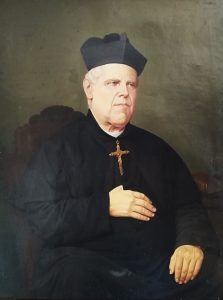
Born in Lisbon, in the parish of Socorro, on 8 March 1810, Father Raimundo dos Anjos Beirão was a man of open spirit, joyful disposition, and unwavering integrity. From his youth, his life was a living testimony of love for God, expressed in total dedication to the poorest, always guided by an unshakeable trust in Divine Providence.
He professed in the Third Regular Order of Saint Francis, taking the name Fr. Raimundo of Saint Mary of the Angels. Ordained a priest in 1833, he carried within him a charity so vast that he would become for Portugal what Vincent de Paul had been for France: a beacon of hope in a time of darkness.
Not even the anti religious fervour of liberal ideas, which expelled him from the convent in 1834, could extinguish his apostolic zeal. On the contrary, persecution gave him new dynamism. As Chaplain of the Royal Navy and of the Recolhimento of Our Lady of the Rose, Father Beirão knew no rest; his determination drove him tirelessly wherever there was “some Good to be done”.
A visionary, he founded the Association of the Sons of Saint Cajetan to educate poor boys and prepared young men discerning a vocation to the priesthood. His voice, renowned for his gift as a great sacred orator, travelled across the country, while his shepherd’s heart supported the community of the Capuchin Sisters of Aldeia Galega — the seed of the future Congregation.
He died on 13 July 1878, in the Convent of the Trinas, consumed by a malignant illness, yet leaving behind an eternal legacy. Father Beirão was not merely a Founder; he was the driving force who taught that true Hospitality is born of total trust in God and humble service to one’s neighbour.